One Clear Aim or a Circuit of Drills?
Choose a rugby training session format that fits your players, space and coaching aim, with clear guidance on when repetition or rotation serves best.
The common mistake in planning a rugby training session is choosing drills because they look varied, then discovering that players have spent more time changing stations than learning. The reverse mistake—repeating one activity until attention wanders—costs focus in a different way. Choose between a focused block and a circuit by asking what the players need to notice and how much organization the group can manage.
What does each session format ask of players?
A focused session keeps the group on one skill or decision for a sustained block. Players repeat the activity, receive a cue, and try again. That suits a coach who wants to make one detail visible, such as staying square before a tackle or presenting the ball clearly after contact.
A circuit rotates players through several activities, often in small groups. It can combine different demands—handling, footwork, support lines, or conditioning—without asking the whole squad to do the same thing for long. The trade-off is organizational: players need to know where to go, what to do, and when to move.
Neither format is inherently more demanding or more effective. Their value depends on the aim, the players’ experience, the available space, and how reliably the coach can keep the activity moving.
When does a focused block fit best?
Choose one clear aim when a skill is unfamiliar, a recurring error needs attention, or players need a calm setting to understand a decision. Newer players often benefit from seeing the same cue more than once; a changing menu of activities can make it hard to tell which detail matters.
Focused blocks also suit small spaces and groups with uneven numbers. One activity is easier to adapt when a player arrives late, a field area becomes unavailable, or the coach needs to divide attention among several experience levels. Keep the task simple, but adjust its difficulty: change the distance, add a passive defender, or ask players to make the decision at a different point.
Repetition should still contain a reason to pay attention. A player can perform a movement often without noticing whether it solves the problem. Give one concise cue, allow a few attempts, then ask what changed in the result. If quality fades or the cue stops making sense, pause, simplify, or move to a related task rather than insisting on repetition for its own sake.
When is a circuit the better choice?
A circuit fits a group that can work independently and benefit from shifting among related demands. It is useful when the session has several modest aims, players need frequent changes of activity, or the coach wants small groups engaged at once instead of waiting in a long line.
Keep the stations connected by a shared theme. For instance, handling under pressure, supporting the carrier, and reacting after a turnover can all serve a session about keeping possession. A collection of unrelated drills may feel lively, but players have to work out a new purpose at every stop.
Use a circuit cautiously with beginners, a crowded training area, or a coach who cannot supervise all stations. Complex instructions and equipment changes can turn rotation into a queue-management exercise. Fewer stations, clear boundaries, and familiar activities usually make a circuit easier to run. Follow relevant club procedures and equipment guidance where they apply.
How do you choose for your group?
What suits players who are new to the skill?
Start with a focused block so players can recognize the movement and the coach can give one useful cue. Add variation only when the group can explain what the activity is asking them to do.
What suits a large squad with limited space?
A circuit can keep smaller groups active, provided stations fit the space and do not interfere with one another. If supervision or boundaries are difficult, use one shared activity with several small lanes instead.
What suits players who are losing concentration?
Try a related circuit if the group already understands the activities and transitions are simple. If attention has dropped because the task is unclear, changing stations will not fix the underlying problem; shorten the explanation and reset the focused drill.
What suits a session with one specific weakness to address?
Choose a focused block when you can name the weakness and describe the change you want to see. A circuit may still help later, but several unrelated tasks can dilute the point before players have grasped it.
How can you organize a circuit without losing the session?
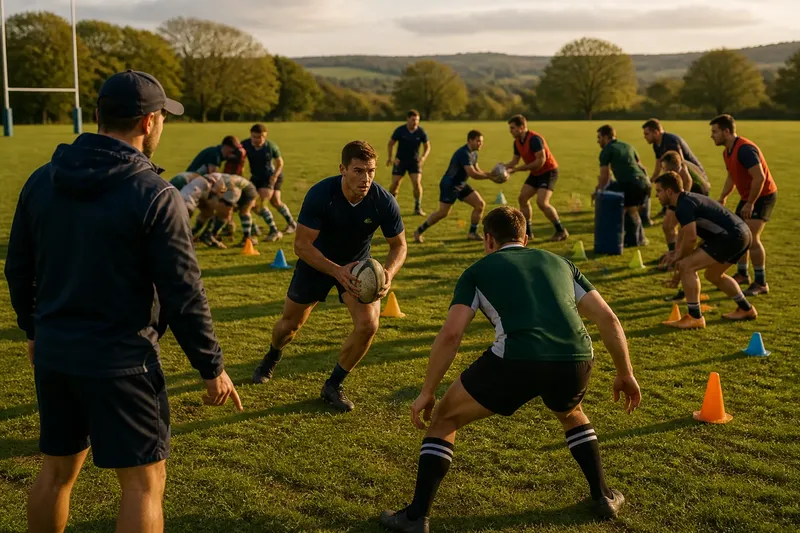
Set the route before players arrive. Use cones to mark station boundaries, put any needed balls or tackle shields at the relevant spot, and give each group a starting point. Explain the activity and the rotation in plain language before the first move; a demonstration is often clearer than another paragraph of instructions.
Keep transitions predictable. A coach’s call, a whistle, or a visible cue can signal when groups rotate. Leave enough room for players to move safely, and avoid placing a station where a neighboring group’s activity crosses its path. If the layout cannot support all stations at once, remove one rather than asking everyone to improvise.
Imagine a coach with a mixed-experience squad and one available training area, aiming to improve decision-making when a defender closes in. The coach could begin with a focused activity where a ball carrier chooses between two clear options, using one cue to help players read the defender. If players can make that choice reliably, the coach might then rotate groups through related handling and support activities; the observable goal is that the same decision remains clear when the setting changes.
Can you combine repetition and rotation?
Yes. A useful session can begin with a focused block, then move to a circuit that asks players to apply the same idea in different settings. The order matters: establish what to look for before adding extra decisions, equipment, or movement between stations.
There is no need to use both formats every time. If the central skill remains uncertain, stay with a focused activity and make a modest adjustment. If players are ready to apply it and the logistics are manageable, rotate among connected tasks. For a rugby training session, the best format is the one that keeps the aim visible while giving players a sensible amount of challenge—and leaves enough of the practice for playing, not just explaining.