Why Rugby Teams Huddle Before the Match
Why rugby teams huddle before the match: understand how a concise shared cue can focus players, clarify the final message and carry into kickoff.
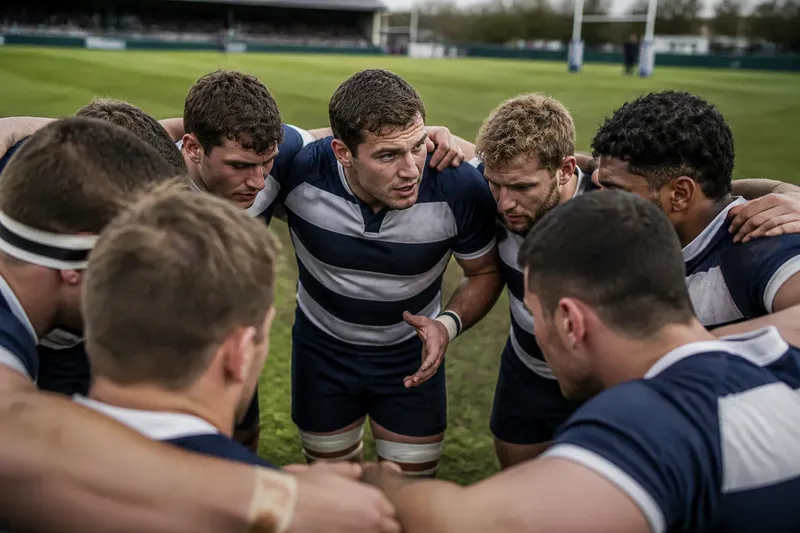
Teams often mistake a pre-match huddle for a chance to deliver one last speech. The cost is a crowded message at the moment players need to take their positions. Why rugby teams huddle before the match is simpler: the gathering gives the group a clear, shared cue before play begins.
What does a rugby huddle do before the match?
In the minutes before kickoff, players are finishing different tasks: checking boots, completing warm-ups, listening for instructions or confirming details with officials. A huddle draws their attention to one shared moment without pretending those separate jobs have vanished.
It can also give the captain or another agreed leader a chance to recall one intention the team has already discussed. The huddle is not the place to settle a complicated tactical question; it is the last prompt before players put the plan into action.
The ritual need not make everyone feel excited. A quiet group can use it just as well as a loud one. Its value is in making the start deliberate, not in producing a particular mood.
Why do teams gather closely rather than line up?
A circle lets players see one another and hear a short message without a microphone or a formal address. It also makes the gathering visibly collective: the captain may speak, but the whole group is present for the cue and the response.
That does not mean each player has the same job. Forwards, backs and substitutes may be preparing for different tasks, while still sharing the same opening intention. A useful huddle acknowledges that connection without flattening the roles into one generic instruction.
What should the captain say in the matchday huddle?
A concise reminder works best when the players already know what it means. “Talk early” is useful only if the team has agreed what communication it expects; “support the next carrier” is useful only if it recalls a familiar responsibility. New tactical detail belongs in an earlier conversation where players can ask questions.
Say a fictional club side has agreed before the match to call clearly when a teammate is isolated. As the team gathers, the captain repeats that cue, the players answer with their customary call, and they break. The observable outcome is that the group leaves with one shared reminder; whether it helps in play depends on what the players do next.
Silence can be part of the moment, too. If the plan is settled, a pause may be more useful than a final speech. Rugby already offers enough opportunities to hear someone talk over someone else.
How can every matchday role feel included?
Inclusion does not require every player to speak. A player can take part by listening, making eye contact or joining a familiar team response. Pressuring people to perform enthusiasm can turn a shared ritual into an audition.
Substitutes can be included in the gathering while keeping their distinct matchday role clear. On a developing or mixed-age side, plain language helps everyone understand the cue; private jokes and dense shorthand tend to serve the people who already know them.
How can a team keep its huddle useful?
Keep the routine familiar enough to recognize, but do not choreograph it for appearance alone. A captain can decide beforehand what needs saying, while a coach can cover tactical corrections and logistics before the group gathers.
- Check audibility: If players cannot hear the speaker, gather in a suitable place or ask the speaker to face the group; otherwise, keep the location and continue.
- Check the message: If the cue introduces an unfamiliar tactic, move that discussion earlier; otherwise, use the agreed reminder.
- Check the number of cues: If several unrelated points compete for attention, choose the one the team has agreed matters most; otherwise, keep the concise message.
- Check who is speaking: If several people are about to add last-minute speeches, let the agreed leader deliver the cue; otherwise, allow the planned speaker to continue.
- Check participation: If the response pressures someone to perform, use a familiar inclusive call or let listening count; otherwise, keep the team’s usual response.
- Check match arrangements: If the gathering would block officials or conflict with their directions, move or end it; otherwise, break when the message is complete.
These choices should fit the club and the matchday arrangements. The huddle is a team custom, not a reason to ignore an official’s instructions.
What questions do players ask about a pre-match rugby huddle?
Should the captain repeat the whole game plan?
No. Use the huddle for a familiar reminder, not a full tactical review. Detailed information belongs earlier, when players have room to consider it and ask questions.
Does every player need to speak?
No. Listening or joining a familiar response can be enough. The aim is shared attention, not a roll call.
Should a team use the same huddle every match?
A familiar shape can help players recognize the routine, but the wording does not have to stay fixed. Keep what helps the group focus and change what feels forced or distracting.
What if the team is already tense?
The huddle does not need to manufacture excitement or dismiss nerves. A calm, clear cue can point players toward the next action without promising how the match will go.
How does the huddle carry into kickoff?
A cue matters only if players can recognize it once play starts. If the huddle recalls communication, the opening exchanges give the team a chance to use clear calls; if it is only a slogan, the words may have little practical connection to what follows.
That is the useful answer to why rugby teams huddle before the match: the group creates a brief shared pause, recalls an agreed intention and then breaks to play. A captain can make the ritual more useful by choosing a cue players already understand, leaving the detailed conversation for earlier and yielding to matchday instructions when required.