The Pass That Arrives Before the Runner
Learn to pass ahead of a moving rugby teammate so they can catch in stride, using simple practice cues to judge the line, pace and release.
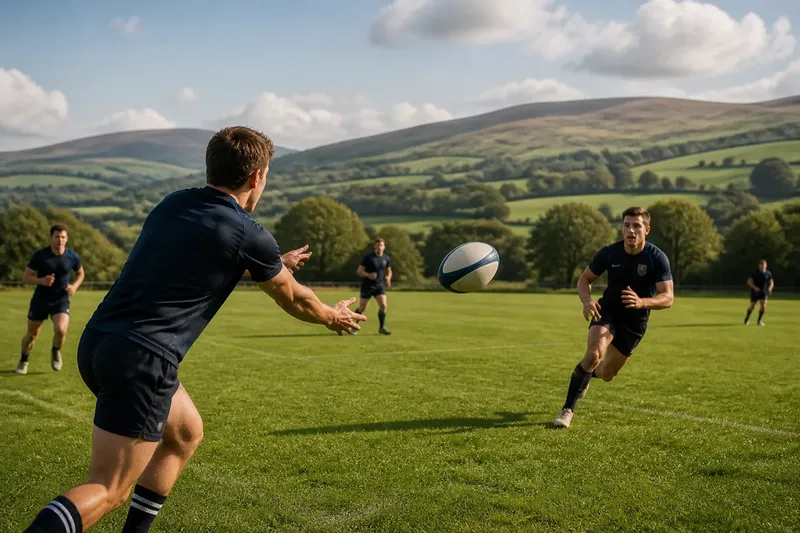
The common mistake in a rugby pass is aiming at the teammate’s hands as they are now. By the time the ball gets there, the runner has moved on, and a catch that should preserve momentum becomes a reach, a stutter or an awkward stop. Passing slightly ahead gives the receiver somewhere to run onto the ball.
This is not a matter of throwing as far ahead as possible. The useful lead depends on the runner’s speed and line, the distance between you, and how quickly the pass travels. In ordinary practice, you can learn to notice the timing without turning every pass into a complicated calculation.
Start with the runner’s line
Before you pass, look at the receiver’s path rather than only at their hands. Are they running straight across your field of view, angling toward the space beyond you, or cutting toward a defender? The pass needs to meet the player along that path, not simply land in the open space they have already left.
For a straightforward lateral pass, picture the runner continuing at the same pace for the brief moment the ball is in flight. Aim for the point where that path and the ball’s path can meet. A small lead is often enough when the receiver is close; a longer pass or a faster runner calls for more space in front.
Keep your eyes moving between the runner and the available space. If you watch only the ball, you lose the information that sets the lead. If you watch only the runner, you can miss whether a defender or another teammate is about to occupy the intended lane.
Set your body before the release
Get balanced enough to pass without falling across your line. Turn your shoulders and hips toward the intended target, and bring the ball into a position from which you can use both hands. Your feet do not have to be planted in a pose; the aim is to keep the pass controlled while your body is moving.
As the receiver approaches, identify the space just ahead of their chest or outside shoulder, depending on their route. On a flat run across the field, the pass should generally lead along the direction of travel. If the runner is angling forward, the target shifts along that diagonal instead of staying level with you.
Do not decide the lead by reaching your arms farther at the last moment. That tends to make the pass float or wobble, and it leaves little room to adjust. Prepare the passing shape early, then release toward the moving target with a smooth action that suits the distance.
Choose a lead the runner can use
A useful pass reaches the receiver where they can catch it without breaking stride or twisting sharply. Too little lead makes them check their run or reach backward. Too much lead sends them chasing the ball, often toward the touchline or into a defender’s path.
Think of the lead as a small patch of space, not a fixed distance. A receiver moving quickly across a longer gap may need the ball farther ahead than a teammate jogging nearby. Wind, a slippery ball, the angle of the pass and the quality of the catch can also change what feels comfortable.
When the intended space is crowded, do not force a pass simply because the runner is moving. A defender may be able to intercept a ball that travels through the lane, or the receiver may have no room to continue after catching. The pass should give the teammate a usable next action, not merely arrive somewhere in front of them.
Watch what happens after the catch
The clearest timing cue comes after release. Did the receiver catch the ball while still running through the same line, or did they slow down to meet it? A clean catch in stride suggests the lead was close to useful. A reach behind, a sideways twist or a sudden brake tells you the target needs adjustment.
Notice the receiver’s hands as well as their feet. If they have to stretch back toward the passer, the ball was likely behind their movement. If they reach far ahead and lose control, the lead may have been too large or the pass may have arrived too quickly for that distance. These are clues, not verdicts; a defender’s pressure or a poor bounce can affect the result.
Say you are passing to a teammate jogging across a quiet training area, and they keep catching the ball just behind their body. On the next pass, you watch their line, aim a little farther ahead, and check whether their steps continue through the catch. The observable change you are looking for is a catch with less reaching and no obvious pause, not a perfect pass on the first adjustment.
How can you notice the timing in ordinary practice?
What should I watch during a passing drill?
Watch whether the receiver’s running rhythm changes at the catch. A smooth continuation is a useful sign that the ball met their movement; a visible check-step or reach backward gives you a reason to lead slightly more.
Should the receiver call for the ball?
A call can help you identify when they are ready, but it does not replace watching their route. Use the call as one cue, then judge the line and pace the receiver is actually taking.
How far ahead should I pass?
There is no single lead that suits every distance and speed. Start with enough space for the runner to meet the ball without reaching behind, then adjust in small amounts based on what happens at the catch.
What if the pass keeps going too far in front?
Bring the target closer to the receiver’s current position and check whether the ball itself is being sent too hard. A long lead and a forceful pass can combine to make the catch difficult even when the line is sensible.
Adjust one cue at a time
During a normal passing exercise, keep the task simple: watch the receiver’s line, release toward the space ahead, then observe the catch. If the ball arrives behind, increase the lead slightly. If the receiver has to chase, reduce it. Changing one cue at a time makes it easier to notice what helped.
You can also ask the receiver for a brief, specific response: “Did you catch that in stride?” This is more useful than asking whether the pass felt good, which can produce a polite answer and no usable detail. The passer and receiver can compare what they saw without turning the drill into a running commentary.
When practice includes defenders, retain the same timing cue but add the defender’s position to your decision. A pass into open space is only useful if the receiver can reach it before the opponent closes the lane. If the route is shut, keep possession or choose another option rather than increasing the lead and hoping the problem develops manners.
Keep the pass suitable for the situation
At close range, a compact pass with a modest lead may let the receiver continue immediately. Across a wider gap, the ball may need a firmer, longer flight, and the receiver may need to run a clearer line to meet it. These are adjustments to the same idea: place the ball where the teammate is going, with a pace they can handle.
In a match, defenders and teammates can change the space between the moment you look and the moment you release. Keep scanning, and avoid locking onto a target before you know whether the lane remains open. A pass that arrives ahead of the runner should also arrive in a place that leaves them options.
For the next practice, remember the phrase “line, lead, catch.” Read the runner’s line, send the ball a little ahead, and judge the result by whether they can continue through the catch. That simple observation is enough to make the pass ahead of the runner more deliberate, without treating every exchange as a geometry lesson.